

mayo 1, 2026

Distribution patterns of hummingbird richness in tropical dry forests in the Colombian Caribbean
Distribution patterns of hummingbird richness in tropical dry forests in the Colombian Caribbean


Distribution patterns of hummingbird richness in tropical dry forests in the Colombian Caribbean
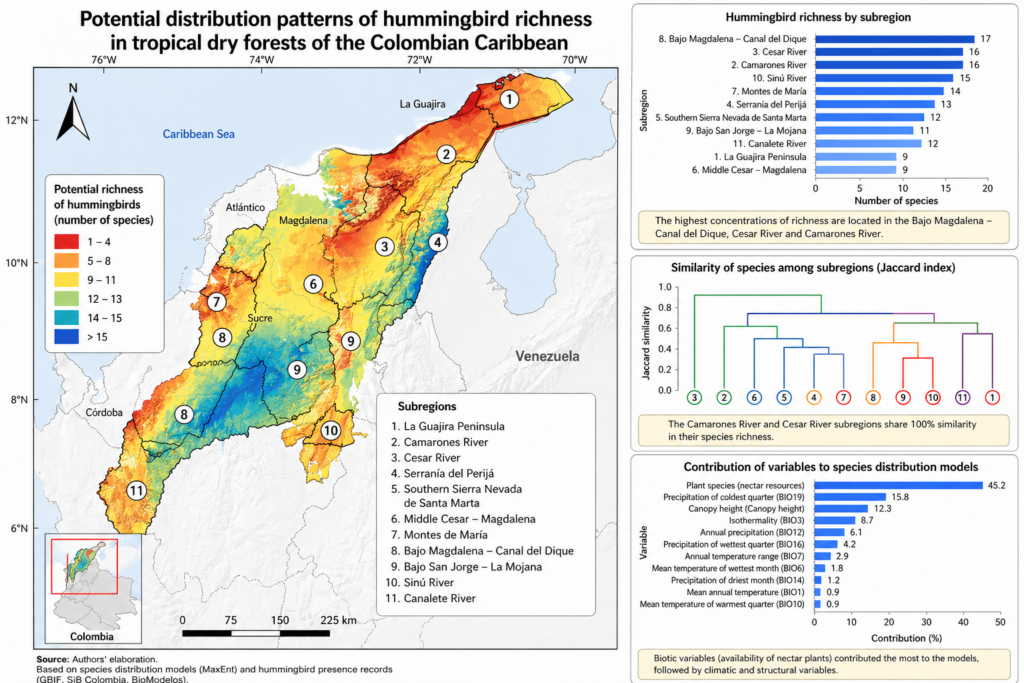
Introduction: The heterogeneous ecological conditions of the tropical dry forest in the Colombian Caribbean may have an eff ect on key species such as hummingbirds, pollinators that are sensitive to the structure and com-position of this ecosystem. Objective: To describe the spatial distribution patterns of hummingbird (Trochilidae) richness in the tropical dry forest (TDF) of the Colombian Caribbean. Materials and methods: Using species distribution models. 3,693 georeferenced records of hummingbird presence from public platforms such as GBIF, SiB Colombia, and BioModelos. Models were constructed in the R and MaxEnt programs using biotic variables (models of the distribution of nectar-producing plant species), structural variables (canopy height), and climatic variables (precipitation and temperature). Spatial filters and principal component analysis (PCA) were applied, and model performance was evaluated using metrics such as AUC and AICc. Results: A non-homogeneous dis-tribution of hummingbird richness was observed, with the identifi cation of 11 subregions within the BST, each with diff erent combinations of species. The highest concentrations of species richness were located in Tayrona National Natural Park, Montes de María, and Bajo Magdalena. Biotic variables contributed most to the models, followed by precipitation during the coldest quarter and canopy height. Conclusion: Hummingbird species rich-ness in the Colombian Caribbean BST. Translated with DeepL.com (free version)

Keywords: Niche, endemism, environmental gradients, ecological heterogeneity.

https://doi.org/10.47499/revistaaccb.v1i38.338


About The Author