
diciembre 30, 2025

Bacterial consortium to degrade sulfur compounds and mitigate gases and odors in wastewater
Bacterial consortium to degrade sulfur compounds and mitigate gases and odors in wastewater

Bacterial consortium to degrade sulfur compounds and mitigate gases and odors in wastewater

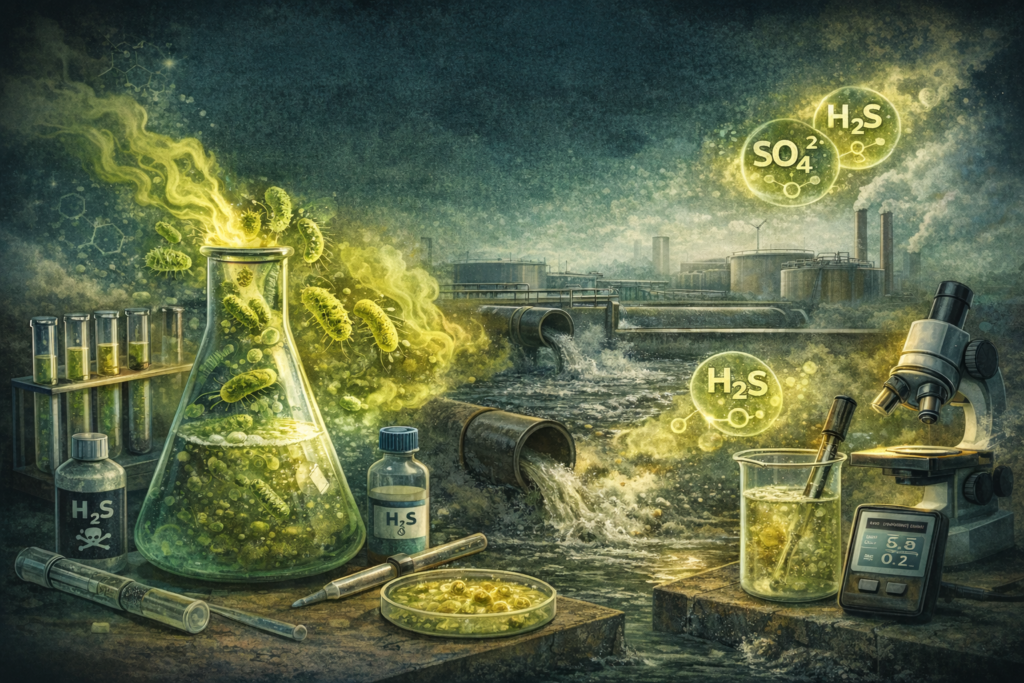
Introduction. The presence of sulfur compounds in wastewater is an environmental problem due to their toxicity and the generation of unpleasant odors. Sulfur-metabolizing bacterial consortia represent an efficient alternative for their degradation. This study evaluated a bacterial consortium composed of Aeromonas spp. and Pantoea agglomerans, isolated from the La Marina WWTP (Armenia, Quindío), for the bioremediation of sulfur compounds in domestic wastewater. Objective. To isolate and characterize a bacterial consortium (Aeromonas spp. + P. agglomerans) and evaluate its ability to degrade sulfur compounds in wastewater. Materials and methods. A bacterial consortium was isolated and formed from samples from the La Marina WWTP. NaSO tolerance tests and incubation tests in wastewater under real conditions were performed. The decrease in sulfur compounds was evaluated using FTIR and Raman spectroscopy, and pH and dissolved oxygen were also recorded before and after treatment as indirect measures of HS reduction. Results. The strains tolerated concentrations of up to 20 mg/L of NaSO without significant inhibition. P. agglomerans showed a greater capacity to remove sulfur compounds than Aeromonas spp. In addition, no inhibition was observed in co-culture and synergy was present. FTIR and Raman analyses, together with an increase in pH from ~6.9 to ~8.3 and in dissolved oxygen from ~0.15 to ~0.83 mg/L (equivalent to a 4.86-fold increase), showed a decrease in sulfur compounds after treatment. Conclusions. The bacterial consortium demonstrated efficacy in the bioremediation of sulfur compounds and improved effluent quality, demonstrating its potential biotechnological application.

Keywords: Bioremediation, sodium sulfate, dissolved oxygen, FTIR, Pantoea agglomerans, Aeromonas spp.

https://doi.org/10.47499/revistaaccb.v1i37.332

About The Author