
diciembre 30, 2025

Effect of ultraviolet B radiation on the thermal preference of Engystomops pustulosus tadpoles
Effect of ultraviolet B radiation on the thermal preference of Engystomops pustulosus tadpoles

Effect of ultraviolet B radiation on the thermal preference of Engystomops pustulosus tadpoles
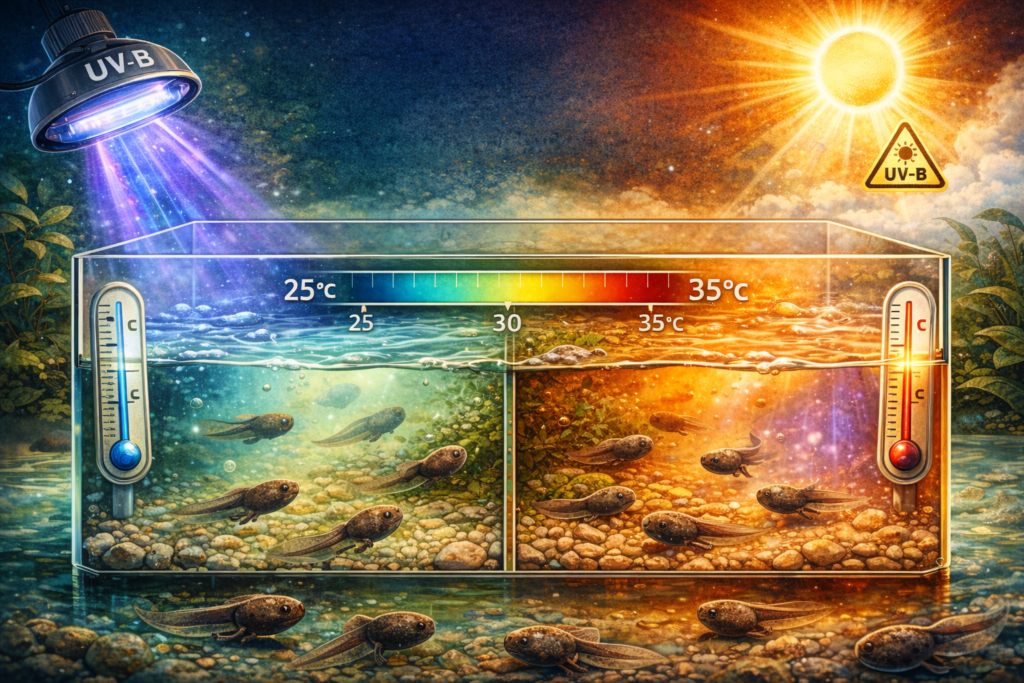
Introduction: Ultraviolet B radiation (UVBR) and temperature are environmental factors that can affect amphibians, especially during their larval stage. Given the importance of thermoregulation for development and survival. Objective: Identify the impact of UVBR on the thermal preference of Engystomops pustulosus tadpoles. Materials and Methods: In the laboratory, tadpoles were exposed for one hour in 120 cm × 7 cm × 5 cm aluminum channels with 3 cm of water depth, where thermal gradients from 25 to 35°C were established, combined with two UVBR levels (low: 5 μW/cm²; high: 100 μW/cm²). Six experimental designs were constructed with different combinations of thermal gradients and UVBR levels. For each design, 45 tadpoles were tested, and after the exposure to UVBR and temperature, their distribution along the thermal and UVBR gradients was determined using the scan sampling method, which consists of recording the position of individuals at fixed intervals. Results: In experiment 1, tadpoles significantly avoided areas with high UVBR, at both high and low temperatures. In experiment 2, tadpoles showed no differences in thermal preference when exposed to constant high or low UVBR. In experiment 3, tadpoles avoided high UVBR at both constant low and high temperatures. Conclusion: Tadpoles of this species avoid high UVBR areas regardless of temperature, suggesting that they prioritize photoprotection over thermoregulation.

Keywords: Amphibians, Behavior, Larvae, Photoprotection, Thermoregulation, Ultraviolet-B rays.

https://doi.org/10.47499/revistaaccb.v1i37.330

About The Author